A Cần Thơ Conversation About Casino Imagery
Use casino imagery in a Cần Thơ discussion to see how framing, captions, and source details shape a message—and leave with a clear record of what remains unknown.
Casino imagery in a Cần Thơ discussion is easier to analyze when the group follows how the message is built, from crop to caption to placement. A film still, advertisement, or public venue image can prompt close attention to those choices without requiring anyone to guess what a whole region thinks about casinos.
This works for a student club, classroom, or a few friends over coffee. Keep the conversation grounded in what the image and its accompanying material actually show. There is no need for anyone to share personal experiences.
How should you choose casino imagery for a Cần Thơ discussion?
Choose one still image with visible details the group can describe, such as an advertisement, a film frame, or a picture from a public-facing venue page. Keep its original caption and source information nearby, while treating both as material to examine rather than a complete account.
- Check whether the image is clear enough to inspect; if its details are legible, use it, but if they are blurred, choose a clearer image.
- Check whether you can identify its source; if you can, record the name or page, but if you cannot, mark the source unknown and avoid claims about its purpose.
- Check whether the caption names a place; if it does, record the wording as caption information, but if it does not, leave the location unresolved.
- Check whether people are shown prominently; if the image invites guesses about identity or motive, choose a less personal image, but if it does not, still avoid making those guesses.
- Check whether the image combines several scenes; if it does, select one frame to discuss, but if it does not, keep the group focused on the single scene.
- Check whether everyone can see the image comfortably; if not, enlarge it or choose another, but if so, show the source alongside it.
Searching for the most provocative image is not worth the effort. A quiet room scene can offer plenty to discuss about light, cropping, and wording without pulling the conversation toward spectacle.
What can framing and captions tell the group?
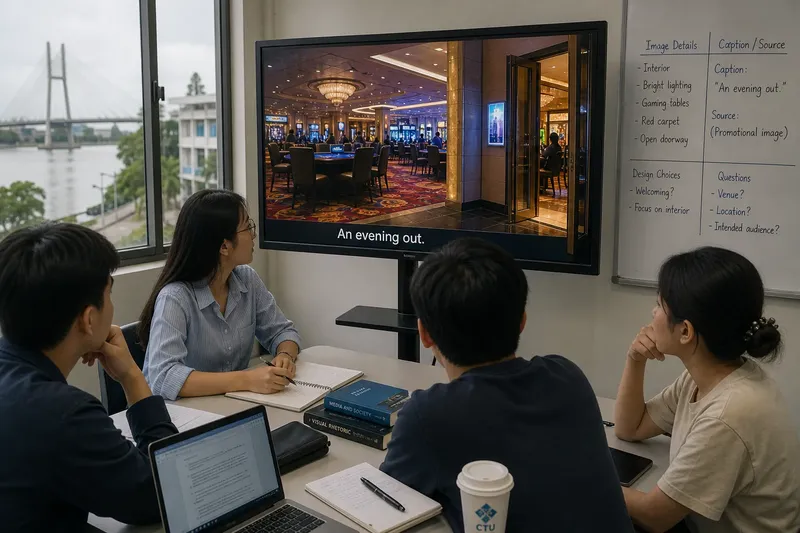
Give everyone a moment to look before asking for interpretations. On a whiteboard or sheet of paper, record concrete features such as color, lighting, objects, visible text, camera angle, and what sits near the center or edge. Put caption wording and source details in a separate column.
Imagine the group is looking at an invented promotional image: a bright interior, a doorway near the right edge, and the caption “An evening out.” First, write down the interior, doorway, and exact caption in separate places. Then ask what impression the design might create. If someone calls it welcoming, note that the bright room and open doorway may support that reading; if someone finds the caption too vague to interpret, record that response too. The image does not identify the venue or its location, so leave both unanswered.
These observations lead to visual rhetoric: the choices that can invite a response. A close crop may focus attention on a room while hiding its surroundings. A lively slogan may suggest excitement, while a subdued palette may make the same scene feel formal. Those are interpretations of design, not evidence of the creator’s intention.
How can regional context add meaning without becoming the whole discussion?
Use Cần Thơ as the setting for the conversation, not as a visual answer key. If a caption names a place or a sign is readable, record exactly what it says and distinguish that evidence from your own inference. If the image supplies no location, do not assign one based on scenery, language, or appearance.
Instead of trying to predict how people in the Mekong Delta would react, examine how the image addresses a viewer. Does its wording name a place, suggest a particular occasion, or leave the audience broad? The group can discuss those visible choices without turning one image into a claim about local tastes or experience.
What questions help analyze casino imagery?
How do you separate visible details from a caption’s claims?
Write what appears in the image in one column and the caption’s wording in another. If a claim appears only in the caption, attribute it to the caption rather than saying the image proves it.
What if two viewers interpret the same design differently?
Record both readings and ask which details led to each one. If the image cannot settle the difference, preserve both interpretations rather than forcing agreement.
How can you discuss the intended audience?
Point to audience cues such as language, place names, or references in the text. If the image names no audience, describe that uncertainty instead of claiming it represents Cần Thơ or the wider Delta.
What if outside information changes the interpretation?
Note the information’s source and place it in a separate context column. If its relevance is unclear or you cannot verify it, keep it out of the group’s conclusions.
How can you leave a useful record?
End with three notes: one design choice, one audience cue, and one question the available material cannot answer. For the invented “An evening out” image, the record might read: bright interior and doorway near the edge; upbeat but broad wording; venue and location unidentified. That keeps the discussion tied to visible choices and makes its limits clear.
A Cần Thơ conversation about casino imagery can also note where the image appeared, since placement may affect how viewers encounter its message. Keep that fact separate from claims about how anyone responds. This small distinction helps the group describe the communication it can inspect without pretending the picture tells a larger story.